Concealed Curtain Tracks and Gypsum Curtain Boxes: A Dubai Guide
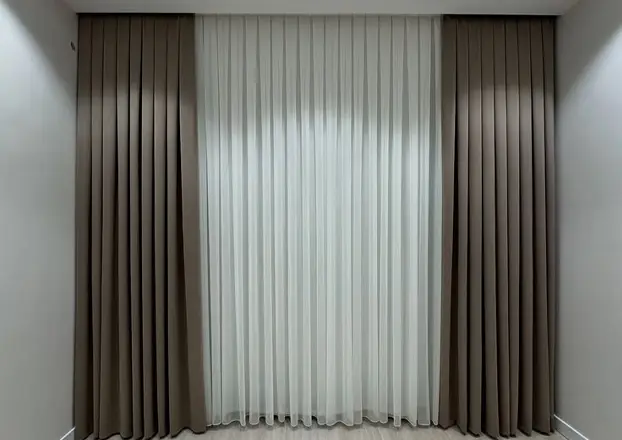
Walk into most new Dubai apartments and villas and you will see a slot in the ceiling above the windows. That is a curtain box, also called a curtain pocket or ceiling recess, built so the curtain track can be hidden. When it is used well, the curtains look like they fall from the ceiling itself. When it is the wrong size, it causes endless problems.
Quick answer: A concealed curtain track sits inside a gypsum curtain box or ceiling recess, so the curtains appear to fall straight from the ceiling with no visible hardware. The box needs to be deep and wide enough for every track you want (about 10 to 15 cm deep for one track, more for a double), and the track must be fixed into solid backing inside the box, not just into the gypsum board.
Types of concealed track
- Gypsum curtain box: a recess built into the false ceiling along the window wall
- Recessed ceiling track: a slim track set flush into the ceiling board
- Pelmet: a box or panel fixed in front of a wall-mounted track to hide it
- Bulkhead with a slot: common where the AC duct runs above the window
How deep and wide should a curtain box be?
The box must fit every track you want, with space for the curtain to move freely. As a guide:
- Single track: about 10 to 15 cm deep, at least 12 cm wide
- Double track (sheer plus blackout): about 20 to 25 cm wide
- Motorized track: extra width at one end for the motor
- Wave curtains: allow for the deeper wave folds
A box that is too narrow forces you to choose between a sheer and a blackout layer, or makes the curtain rub against the window glass.
The fixing is the hard part
Inside the box, you are usually looking at gypsum board on a metal frame. A track screwed only into the board will pull out under the weight of the curtains, often within a few months. The track must be fixed into the metal channels, into timber backing installed during construction, or with anchors designed for hollow ceilings. Our guide on hanging curtains on a gypsum ceiling explains the methods.
Retrofitting into an existing box
Most homeowners inherit a box from the developer. Before buying curtains, measure its width and depth and check what is above it with a small test hole or a stud finder. If the box is too shallow for a double track, a slim double track or a sheer on a single track plus a blackout blind on the window frame can solve it.
Hidden track with motorization
Concealed boxes are ideal for motorized curtains because the motor is hidden too. Plan a power point inside or near the box. Read are motorized curtains worth it before deciding.
Pelmets when there is no box
If your ceiling has no box, a fabric or timber pelmet fixed above the window can hide a wall or ceiling track. It also cuts light leaking over the top of blackout curtains.
Common problems we see
- Track fixed to gypsum only, sagging or falling out. See curtain track fell down.
- Box too narrow for two tracks
- AC grille inside the box, blowing the curtains
- Curtains rubbing on the glass because the box sits too close to the window
Frequently asked questions
Can a curtain box be added to an existing ceiling?
Yes, by building a new gypsum bulkhead, but it is a ceiling job. A pelmet is a quicker alternative.
Will a wave curtain fit in my curtain box?
Usually, if the box is at least about 15 cm wide for a single wave track. Measure before ordering.
Why does my curtain stop short of the box ends?
The track may be shorter than the box, or the end stops are set inside. A longer track lets curtains stack fully clear of the window.
Related guides
- Curtains for Bay and Corner Windows: Track Options That Actually Work
- Curtain Rod vs Curtain Track: Pros, Cons and Which to Choose
- What Is a Wave Curtain Track, and Is It Worth It?
Have a curtain box that needs the right track? Our curtain rod and track installation team fits single, double and motorized tracks into gypsum boxes across Dubai.